
Planning the right garden bed layout can make the difference between a garden that feels crowded and one that is productive, organized, and easy to maintain.
Whether you are starting your first vegetable garden, designing several raised beds, or trying to make the most of a small backyard, a thoughtful layout helps you use your available space efficiently while giving every plant enough sunlight, air circulation, water, and room to grow.
From simple 4×8 raised garden bed layouts to compact square-foot gardens and creative backyard designs, this guide covers practical garden bed layout ideas for beginners and experienced gardeners alike.
What Is a Garden Bed Layout?
A garden bed layout is the planned arrangement of your planting beds, vegetables, herbs, flowers, pathways, trellises, and other garden features.
A good layout answers several important questions:
- Where should each garden bed go?
- How wide should the beds be?
- How much space should be left between beds?
- Which vegetables should grow together?
- Where should tall plants go?
- How can you maximize sunlight?
- How can you make watering and harvesting easier?
The goal isn’t simply to fit as many plants as possible into a garden. The best vegetable garden layout balances productivity, accessibility, sunlight, plant spacing, and maintenance.
Why Garden Bed Layout Matters
A well-planned garden can make gardening significantly easier.
Instead of planting randomly and discovering later that tomatoes are shading your lettuce or that you cannot reach the center of a bed, you can solve these problems before planting.
A thoughtful layout can help you:
Maximize Growing Space
Using raised beds, vertical supports, and efficient planting patterns can help you grow more food without requiring a huge backyard.
Improve Accessibility
Paths between beds make it easier to water, weed, prune, and harvest without stepping on the growing soil.
Improve Sunlight
Tall crops can be positioned so they don’t unnecessarily shade shorter plants.
Simplify Maintenance
When crops are grouped logically, watering, harvesting, and seasonal maintenance become easier.
Create a More Attractive Garden
Garden beds can also become part of your landscape design. Straight paths, repeated shapes, attractive borders, and coordinated planting can turn a vegetable garden into a beautiful backyard feature.
15 Garden Bed Layout Ideas
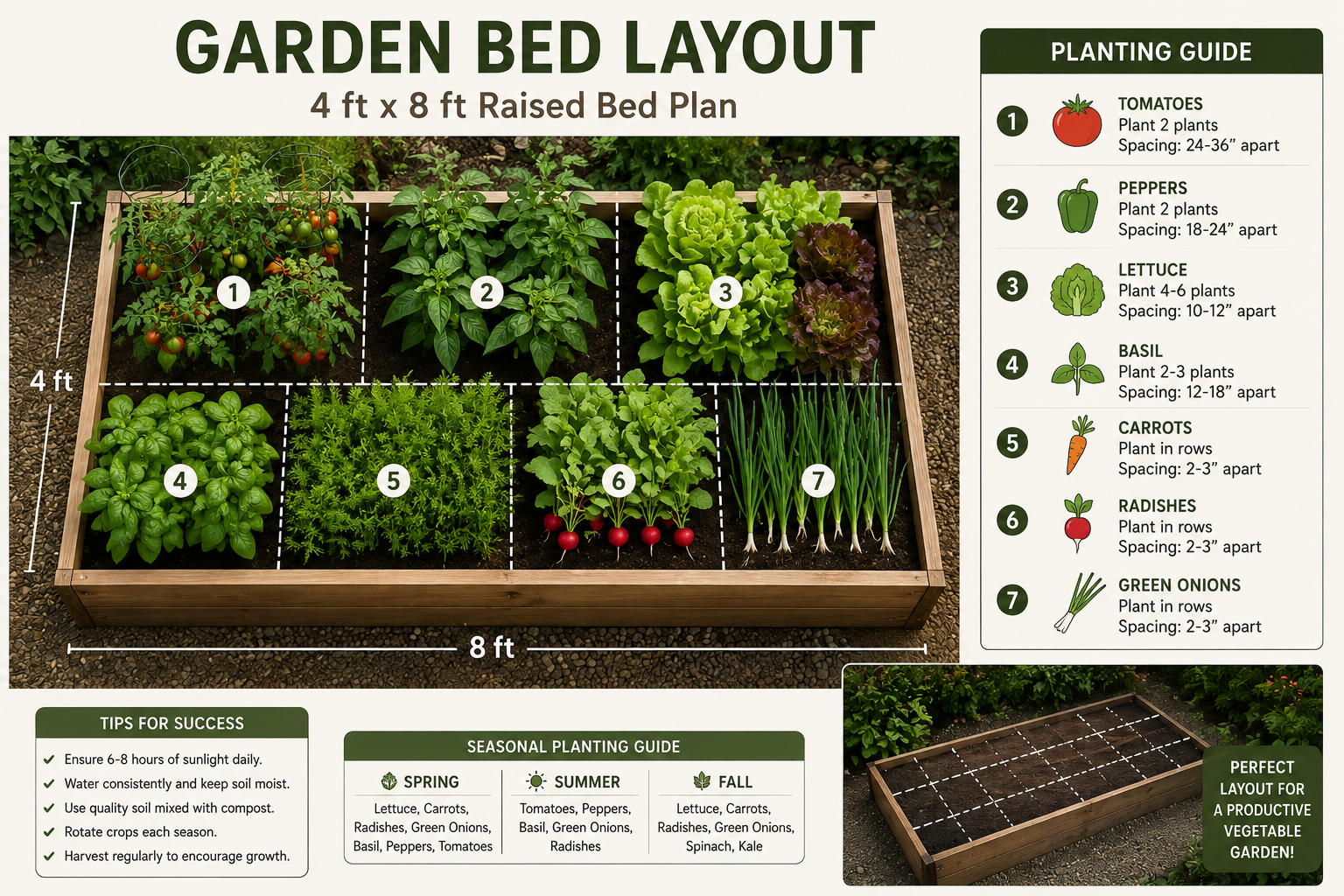
1. Classic 4×8 Raised Garden Bed Layout
The 4×8 raised garden bed layout is one of the most useful configurations for a backyard vegetable garden.
A 4-foot-wide bed can generally be reached from both sides without requiring you to step into the soil, while 8 feet provides enough length to divide the bed into several growing zones.
You could organize a 4×8 bed into sections such as:
- Tomatoes
- Peppers
- Lettuce
- Carrots
- Radishes
- Basil
- Green onions
The exact arrangement should depend on your climate, planting season, and the mature size of each crop.
For larger plants, give them substantially more room than small leafy greens.
Example 4×8 Layout
North side
Tomatoes | Peppers | Cucumbers
Middle
Lettuce | Basil | Carrots
South side
Radishes | Green onions | Herbs
If you use a trellis, place climbing plants where they will not block sunlight from shorter crops.
2. Small Vegetable Garden Layout
You don’t need a large backyard to grow vegetables.
A small vegetable garden layout can work with one or two compact beds, a narrow side yard, patio containers, or even a balcony.
For a small space, prioritize crops that provide a good harvest relative to the amount of room they occupy.
Good choices include:
- Lettuce
- Spinach
- Radishes
- Carrots
- Green onions
- Bush beans
- Herbs
- Peppers
- Compact tomatoes
Vertical gardening is particularly useful in small gardens.
A trellis can allow cucumbers, peas, or climbing beans to grow upward instead of spreading across the ground.
3. Square Foot Garden Layout
A square foot garden layout divides a growing area into smaller sections.
Instead of planting long traditional rows, you organize the bed into squares and assign different crops to each section.
For example, a 4×4-foot bed can be divided into sixteen 1-foot squares.
Each square can contain a different crop depending on the plant’s mature size.
Small crops such as radishes can occupy more plants per square, while large plants such as tomatoes need considerably more space.
This approach is especially useful for beginners because it creates a visual planting plan and helps prevent random overcrowding.
4. U-Shaped Garden Bed Layout
A U-shaped layout provides a large planting area while leaving an open central space.
This design works particularly well in medium and large backyards.
The gardener can walk into the center of the U and access plants from multiple directions.
A U-shaped garden can include:
- Vegetable beds
- Herb sections
- Trellises
- Flower borders
- A central pathway
The shape also creates a natural focal point in the garden.
5. L-Shaped Garden Bed Layout
An L-shaped garden bed is excellent for corners.
Instead of allowing a corner of your backyard to remain unused, you can build an L-shaped planting area along two walls or fences.
This layout works particularly well for:
- Small backyards
- Side yards
- Fence lines
- Patio gardens
- Narrow spaces
Use the longer section for vegetables and the shorter section for herbs or flowers.
6. Garden Bed Layout Along a Fence
A fence can provide an excellent opportunity for vertical gardening.
Build a long, relatively narrow bed along the fence and install a trellis behind it.
Climbing crops such as:
- Cucumbers
- Peas
- Pole beans
- Small climbing flowers
can grow vertically.
This approach is particularly useful when horizontal space is limited.
However, make sure the fence does not create excessive shade before choosing your plants.
7. Raised Garden Bed Layout With Trellis
Adding a trellis can dramatically increase the usable growing area of a raised bed.
Instead of allowing vines to spread across the soil, train them upward.
A raised bed with a trellis can be used for:
Cucumbers: grow vertically on a strong support.
Peas: climb lightweight trellises.
Pole beans: make excellent vertical crops.
Small melons: may require additional support for developing fruit.
A trellis also adds height and visual interest to the garden.
8. Three-Bed Vegetable Garden Layout
If you have enough room, three separate beds can make crop organization easier.
For example:
Bed 1 — Fruiting Crops
- Tomatoes
- Peppers
- Eggplant
- Basil
Bed 2 — Root Crops
- Carrots
- Beets
- Radishes
- Turnips
Bed 3 — Leafy Crops
- Lettuce
- Spinach
- Kale
- Swiss chard
Separating crops can make crop rotation and seasonal planning easier.
9. Four-Square Garden Layout
A four-square layout uses four separate beds arranged around a central pathway.
This is both practical and visually appealing.
For example:
Bed 1: Tomatoes and peppers
Bed 2: Beans and peas
Bed 3: Carrots and root vegetables
Bed 4: Lettuce, herbs, and leafy greens
The central pathway provides easy access to each bed.
This type of arrangement is also suitable for adding decorative elements such as a small fountain, planter, bench, or garden ornament.
10. Narrow Garden Bed Layout
Narrow beds are ideal when space is limited.
Instead of building a wide rectangular bed that is difficult to reach, create several narrow planting areas separated by pathways.
A narrow bed can be particularly useful along:
- Driveways
- Fences
- Walls
- Patios
- Side yards
Keep taller plants toward the back and shorter crops toward the front where appropriate.
11. Herb and Vegetable Garden Layout
Combining herbs and vegetables can make a garden both productive and attractive.
For example:
Center
Tomatoes and peppers
Border
Basil, parsley, thyme, and chives
Corners
Marigolds or other suitable flowers
Herbs can also make harvesting convenient when they are placed near vegetables that are frequently used together in cooking.
For example, tomatoes and basil are a natural combination for a kitchen garden.
12. Small Backyard Garden Layout
A small backyard benefits from careful zoning.
Instead of filling the entire space with beds, create a simple structure:
Raised Bed 1
Vegetables
Raised Bed 2
Herbs and leafy greens
Fence
Vertical trellis
Pathways
Gravel, mulch, or stepping stones
This creates clear zones and prevents the garden from feeling overcrowded.
Use vertical growing wherever possible.
13. Tiered Garden Bed Layout
A tiered garden uses multiple levels.
It can be especially useful on sloped properties because each level creates a more manageable planting surface.
Tiered beds can also create visual depth in a flat backyard.
Plant taller crops toward the upper or rear sections and shorter plants where they won’t be shaded.
Make sure each level has adequate drainage and is structurally secure.
14. Flower and Vegetable Garden Layout
Vegetables don’t have to occupy a separate part of your landscape.
Mixing edible plants with flowers can create a beautiful backyard garden layout.
For example:
- Tomatoes in the center
- Lettuce around the edges
- Basil between larger plants
- Marigolds along the border
- Climbing flowers on a trellis
This approach can make a vegetable garden look more like an intentional landscape rather than a purely functional growing area.
15. Modern Garden Bed Layout
For a contemporary backyard, choose simple geometric shapes.
Consider:
- Rectangular raised beds
- Straight gravel pathways
- Dark metal or natural wood
- Repeated plant varieties
- Minimal garden decorations
Symmetry can make a small garden appear more organized.
For example, two identical raised beds separated by a central pathway can create a clean, modern appearance.
How to Design the Perfect Garden Bed Layout
Before building anything, follow these steps.
Step 1: Measure Your Space
Measure the total length and width of your available gardening area.
Draw the space on paper or use a digital garden planner.
Mark:
- Fences
- Buildings
- Trees
- Patios
- Water sources
- Existing plants
- Pathways
This gives you a realistic picture of what you can build.
Step 2: Observe the Sun
Sunlight should be one of your first considerations.
Most common vegetables perform best with plenty of direct sunlight, although exact requirements vary by crop.
Observe your garden throughout the day and note areas that receive full sun, partial shade, or significant shade.
The direction of the sun also matters.
Tall crops can cast shadows over shorter plants, so consider their final height when creating your layout.
Step 3: Choose Your Garden Bed Size
A common mistake is making beds too wide.
If you cannot comfortably reach the center, you’ll eventually have to step into the bed or stretch across it.
A 4-foot-wide bed is a practical starting point when you can access both sides.
If the bed can only be accessed from one side, a narrower design may be more practical.
Step 4: Plan Your Pathways
Don’t use every available inch for planting.
You need room to walk, carry soil, move tools, water plants, and harvest vegetables.
A pathway also prevents you from compacting the soil inside the beds.
For larger gardens, wider paths can make wheelbarrow access easier.
Step 5: Group Plants by Size
Plant size matters just as much as plant compatibility.
Large plants such as mature tomatoes can overwhelm small crops if they are planted too close together.
Organize plants according to their mature size:
Tall
- Tomatoes
- Pole beans
- Trellised cucumbers
Medium
- Peppers
- Bush beans
- Kale
Small
- Lettuce
- Radishes
- Carrots
- Herbs
This makes the garden easier to manage.
Step 6: Think About Plant Spacing
Never design a garden based only on how the plants look when they are seedlings.
A tiny tomato plant can eventually become much larger.
Overcrowding can reduce air circulation and sunlight and can make maintenance more difficult. Gardening Know How likewise emphasizes that spacing should account for each vegetable’s mature size, growth habit, and root system.
Always check the recommended spacing for the specific variety you are growing.
Step 7: Add Vertical Growing
Vertical gardening is one of the best ways to maximize a small garden.
Install trellises for suitable climbing plants.
This allows you to use the vertical space above the bed instead of relying only on the soil surface.
Vertical structures can also create privacy and make your garden more visually interesting.
Best Plants for a Raised Garden Bed Layout
Not every plant has the same space requirements.
Vegetables
Some of the easiest vegetables to incorporate into a raised bed include:
- Lettuce
- Radishes
- Carrots
- Beets
- Bush beans
- Peppers
- Kale
- Spinach
- Green onions
Herbs
Consider:
- Basil
- Parsley
- Chives
- Cilantro
- Thyme
- Oregano
Vertical Crops
Use trellises for:
- Cucumbers
- Peas
- Pole beans
- Climbing flowers
Large sprawling plants such as pumpkins and many types of squash require much more room and should be included carefully in a compact garden plan.
4×8 Raised Garden Bed Layout Example
One of the most useful layouts for beginners is a 4×8 bed.
Here’s a simple example:
| Section | Plants |
|---|---|
| 1 | Tomatoes |
| 2 | Peppers |
| 3 | Lettuce |
| 4 | Carrots |
| 5 | Radishes |
| 6 | Basil |
| 7 | Green onions |
| 8 | Cucumbers on trellis |
The exact number of plants should be adjusted according to the variety and recommended spacing.
For a real garden, think of this as a planning framework rather than a universal planting prescription.
Garden Bed Layout for Beginners
If this is your first vegetable garden, don’t try to grow everything at once.
Start with one or two beds.
A beginner-friendly combination could include:
- 2 tomato plants
- 2 pepper plants
- Lettuce
- Radishes
- Carrots
- Basil
- Green onions
This gives you several different types of crops without creating an unnecessarily complicated garden.
As you gain experience, you can add additional beds, trellises, herbs, flowers, and seasonal crops.
Garden Layout Mistakes to Avoid
1. Making Beds Too Wide
If you can’t reach the middle comfortably, maintenance becomes frustrating.
2. Ignoring Sunlight
A beautiful layout is useless if your plants don’t receive enough light.
3. Planting Everything Too Close
Plants need room to develop.
4. Forgetting Pathways
You need somewhere to walk and work.
5. Ignoring Mature Plant Size
Plan for the plant you will have in several months, not the tiny seedling you see today.
6. Putting Tall Crops in the Wrong Location
Tall plants can cast shadows over shorter crops.
7. Growing Too Many Varieties
More plants don’t necessarily mean a better garden.
Start with a manageable selection.
How to Make a Garden Bed Layout Look Beautiful
Productivity doesn’t have to come at the expense of appearance.
Use repeating shapes and materials to create visual consistency.
For example, you could use:
- Matching wooden beds
- Gravel paths
- Natural stone borders
- Decorative flowers
- Wooden trellises
- Simple plant labels
You can also repeat the same flowers throughout the garden to create a cohesive look.
A productive vegetable garden can become one of the most attractive parts of your backyard.
Best Garden Bed Layout for Small Spaces
If your garden is small, prioritize space efficiency.
A strong small-space strategy is:
One 4×8 raised bed
One vertical trellis
A narrow herb border
A compact pathway
This gives you multiple growing zones without taking over the entire backyard.
Choose crops that can be harvested repeatedly, such as lettuce, herbs, and some leafy greens, and combine them with productive vertical crops.
Garden Bed Layout and Companion Planting
Companion planting can be incorporated into your layout, but don’t let it override the basic requirements of each plant.
Start with:
- Sunlight
- Plant spacing
- Water requirements
- Soil requirements
- Mature size
Then consider whether plants are suitable neighbors.
For example, placing basil near tomatoes can be convenient for harvesting, while flowers can add color and biodiversity to the garden.
The foundation of a good layout should always be practical growing requirements.
How to Plan Your Garden Layout on Paper
You don’t need expensive software.
Start with graph paper.
Draw each square as one foot.
Then mark:
- Raised beds
- Paths
- Trellises
- Plants
- Water sources
You can also use a digital garden planner to experiment with different arrangements before buying materials.
Garden-planning tools can help with tasks such as mapping beds, crop rotation, plant spacing, and seasonal planning.
Garden Bed Layout FAQ
What is the best layout for a vegetable garden?
The best layout depends on the size and shape of your space. Raised beds with accessible pathways are an excellent choice for many backyard gardens because they organize the growing area and make maintenance easier.
What is the best size for a raised garden bed?
A 4-foot-wide bed is a practical size when you can reach it from both sides. Longer beds can work well as long as you can access the entire planting area.
How many plants can I grow in a 4×8 raised bed?
It depends entirely on what you’re growing. Lettuce, radishes, carrots, and herbs can be planted much more densely than tomatoes, peppers, squash, or other large plants.
Always follow the recommended spacing for the specific variety.
What should I plant in a 4×8 raised garden bed?
A 4×8 bed can accommodate a combination of vegetables and herbs such as tomatoes, peppers, lettuce, carrots, radishes, basil, and green onions. Use a trellis if you want to add vertical crops.
How do I layout a small vegetable garden?
Start with one or two narrow raised beds, leave practical pathways, maximize sunlight, and use vertical supports for climbing crops.
Should raised garden beds be in rows?
Not necessarily. Rows are simple and practical, but U-shaped, L-shaped, four-square, and other layouts can work depending on your available space.
Final Thoughts
The best garden bed layout is one that fits your space, your lifestyle, and the plants you actually want to grow.
You don’t need a huge backyard or an expensive landscaping project to create a productive vegetable garden. A carefully planned 4×8 raised bed, a small square-foot garden, or even a narrow bed along a fence can provide an impressive amount of growing space.
Start by measuring your garden, observing the sunlight, choosing practical bed dimensions, and leaving enough room for pathways. Then organize your plants according to their mature size, spacing requirements, and growing habits.
If you’re working with limited space, combine raised beds with vertical gardening. If you have a larger backyard, consider U-shaped, L-shaped, or multiple-bed layouts.
Most importantly, don’t try to make your first garden perfect.
Start with a simple vegetable garden layout, learn how your space behaves throughout the growing season, and improve your design each year.
A good garden layout isn’t just about where you plant vegetables. It’s about creating a garden that is productive, accessible, easy to maintain, and enjoyable to spend time in.
garden layoutvegetable garden layoutraised garden bed layout4x8 raised garden bed layoutsmall vegetable garden layoutsquare foot garden layoutbackyard garden layoutgarden plannerraised garden bed ideasgarden bed ideas